Comments about Renewal
The religious environmental movement is potentially key to dealing with the greatest problem humans have ever faced, and it has never been captured with more breadth and force than in Renewal. I hope this movie is screened in church basements and synagogue social halls across the country, and that it moves many more people of faith off the fence and into action.
—Bill McKibben
Renewal, Marty Ostrow and Terry Kay Rockefeller’s latest documentary, offers a comprehensive overview of what different religions are doing about the awesome devastation of Earth’s life systems now taking place. The filmmakers’ vision of the problem and understanding of viable solutions show rare depth of perception and are matched only by their sense of the urgency of action if we are to realize our hopes for the future.
—Thomas Berry
I watched this film with admiration and hope millions of others will have the chance to see it. You will be stirred to discover people of different faiths who are engaged in an exhilarating stewardship of the earth that offers our best chance to yet save creation.
—Bill Moyers
Renewal is a path breaking film that gives us for the first time stories of the emerging movement of religious environmentalism across the United States. Here we witness the inspiration of religious ideas in practice for the healing of the Earth. Such a film is invaluable for religious leaders and laity alike. Moreover, it will renew those working on behalf of future generations.
—Mary Evelyn Tucker & John Grim
The Forum on Religion and Ecology
Yale University
I feel like our congregation was jump-started for more eco-commitment simply from seeing the video.
—Rev. Seth Kaper-Dale
Reformed Church of Highland Park, NJ
Living in WV, reading daily about the death and destruction, flooding, etc. caused by coal mining here and elsewhere, one can easily get very depressed. Over the last 30 years I often have felt that our situation is hopeless. Watching this film, with these eight stories, I finally had a feeling of hope - as I have while watching some of the recent MTR films, especially B.J. Budmundsson’s - “God’s Gift of a Wild and Wonderful Land” and “Rise Up! West Virginia.” It’s so easy to watch films about wrong-doing. It’s another to show people how to help stop it.
—Steve Fesenmaier
West Virginia Gazette
Renewal is an inspiring look into how people of diverse faith traditions are organizing, teaching, and joining together to celebrate and protect the environment. Without being at all preachy, each of the eight discrete segments of the film provides a window onto a different part of this growing and critically important movement.
—David Atcheson, Co-chair, the Hazel Wolf Environmental Film Festival, Seattle, WA
[chosen Best of Fest, 2008, Hazel Wolf Environmental Film Festival]
It’s been a wonderful tool for us so far, and we’re about to launch our speaker’s bureau in which we train seminary students to do introductory talks for us. One of those talks will use the two sections of the film in which we appear. So we’ll be making the very most of it, and are so grateful to have it.
—Rev. Dr. Clare Butterfield
Director
Faith in Place
and the Illinois Interfaith Power & Light Campaign
I’ve been using Renewal in religious-environmental education programs for more than a year. It’s an engaging film that sparks excellent conversation while giving people an image - often their first - of what religious leadership for the earth actually looks like.
—The Rev. Fletcher Harper
Executive Director
GreenFaith
Faith in Place has been grateful to be along for the ride in the creation of this film from the beginning. The final product is one that we use with our partner congregations frequently - it’s a wonderful tool to introduce the idea of religious environmentalism into a congregation of any faith in away that is hopeful and open-ended. Not only have I found it to be an invaluable instructive tool, I have found it to be personally inspiring, and a reminder to myself of why I engage in this work.
—Rev. Dr. Clare Butterfield
Director
Faith in Place
and the Illinois Interfaith Power & Light Campaign
I have used this film dozens of times in workshops, classrooms, major lectures and conferences, and it never fails to get people interested, excited and motivated. I think it is the best film out for use in a range of courses that touch on religion and environmental issues. It is essential for any seminary concerned with preparing religious leaders for tomorrow.
—Laurel Kearns
Drew Theological School
Green Seminary Initiative
Regardless of where your church is on its journey for eco-justice, Renewal can serve as an inspirational tool. It provides wonderful examples to inspire action in churches that are just getting started in eco-justice work, as well as churches that have long been active and may be looking for new ideas or a new option for eco-justice education.
—Katie Holmes
Presbyterian Church (U.S.A.)
Environmental Ministries Action Network
Katherine Hayhoe
Check out this recent profile of Katherine Hayhoe, climate scientist and Evangelical Christian – from PBS’ NOVA scienceNOW!
The Producers
Marty Ostrow has been a producer, writer and director for public, commercial and cable television for more than 25 years. His award-winning films include the acclaimed 90-minute documentary America and the Holocaust: Deceit and Indifference, for the PBS series The American Experience. In addition to history, Marty has made many films about science, for NOVA, PBS’s Discover the World of Science, and the Discovery Channel. He was the producer of two hours in the ground-breaking documentary series Race to Save the Planet, the first large-scale PBS effort to bring environmental issues to national consciousness. Excerpts from the extended archival interview Marty produced with cultural historian Thomas Berry are released as Thomas Berry Speaks. Marty’s work is known for the intimate portrait style he brings to his subjects. His public television films about the arts have earned him three Emmy Awards. Marty’s films have been seen in festivals around the world.
Terry Kay Rockefeller has over 25 years experience producing and executive producing award-winning documentaries for PBS. She was a member of the team that created the long-running science series, NOVA. Terry also produced episodes of ODYSSEY, which told anthropological and archaeological stories; The Ring of Truth with MIT professor Phil Morrison; Eyes on the Prize, the celebrated history of America’s civil rights struggles, and The Great Depression. She was series producer of America’s War on Poverty, and I’ll Make Me a World, an examination of African-American arts in the 20th century; and executive producer of Hopes on the Horizon a feature-length documentary produced with a largely African production team. Terry was also executive project manager of On Common Ground, a CD-ROM documenting the religious diversity of present-day America, produced with Harvard professor Diana Eck.
RENEWAL Production Credits
PRODUCED AND DIRECTED BY
Marty Ostrow
Terry Kay Rockefeller
EDITED BY
Peter Rhodes
DIRECTOR OF PHOTOGRAPHY
John Baynard
NATURE MEDITATIONS PHOTOGRAPHED BY
Dan Kowalski
MUSIC COMPOSED BY
Sheldon Mirowitz
ADDITIONAL PHOTOGRAPHY
Michael Chin
Brent Dey
Julius Evans
Morgan Fallon
Tom Hurwitz
John Kelleran
Stephen McCarthy
Marty Ostrow
Adam Singer
Herb E. Smith
David A. Wolf
SOUND RECORDISTS
Raimund Carrillo
Dennis DeVries
Ivan Hawkes
Claudia Katayanagi
Mike Lake
Shirley Libby
Shawn Lind
Benjamin Logan
Gabe Monts
Dave Moon
John Murphy
Brian Peterson
Andy Turrett
AERIAL CINEMATOGRAPHY
Brian Heller
POST PRODUCTION SUPERVISOR
Benjamin Mayer
ADVISORS TO RENEWAL
Mary Evelyn Tucker and John Grim
Yale University
CONTRIBUTING EDITOR
Dick Bartlett
ASSOCIATE PRODUCER
Laura Pacheco
RESEARCH ASSOCIATE
Bonnie Rosenbaum
GRAPHIC DESIGN AND ANIMATION
Edgeworx
ASSISTANT EDITOR
Maud Dillingham
ASSOCIATE ASSISTANT EDITORS
Ricardo Caban
Craig Carpenter
John Meehan
PRODUCTION ASSISTANTS
Julia Kowalski
Duncan Kowalski
Logan Rockefeller Harris
Rosemary West
ONLINE/COLORIST
Dave Allen
AUDIO POST PRODUCTION
Heart Punch Studio
SOUND MIX
Greg McCleary
SOUND DESIGN
Geof Thurber
LEGAL SERVICES
Sandra Forman
NEW MEXICO AERIAL PHOTOGRAPHY COURTESY OF
LightHawk
HURRICANE KATRINA FOOTAGE COURTESY OF
Alisha Tanner
Daniel Trochesset
Mike Yaxzin
Cheryl and Gerald York
WLOX-TV
Factory Farm Footage Courtesy of
Farm Sanctuary
PETA (People for the Ethical Treatment of Animals)
ADDITIONAL STOCK FOOTAGE
America By Air
Corbis Motion
Framepool
Getty Images
Thought Equity Motion
MUSIC
“The Blood Will Never Lose Its Power”
Composed by Andrae Crouch
© Copyright 1966, Renewed 1994 by Manna Music
Courtesy Manna Music All Rights Reserved. Used by Permission (ASCAP)
“Now is the Cool of the Day”
Composed and Performed by Jean Ritchie
©1971 Jean Ritchie
Courtesy of Geordie Music Publishing Company
Deep gratitude to
Jerry Hardt and Kentuckians For The Commonwealth
for their invaluable help
SPECIAL THANKS
Alonzo Printing
Lisa D’Angelo
Berkeley Bowl Marketplace
The Thomas Berry Foundation
David Carnochan
James Carpenter
Center for Social Media, American University
Lance Davis, The Mississippi Press
Derrick C. Evans
Isabella Freedman Jewish Retreat Center
Frank Gerratana
Rev. Kent Gilbert
Brian Heller
Diane Ives
Peter Jaszi
Joaquin Miller Park
Martin Kaplan
Tim Kautza
Laurel Kearns
Catherine Lerza
The Magazine PAPER Project
New Leaf Paper
City of Oakland Film Office
Tovis Page
Lolita Parker, Jr.
Melanie Perkins
Holly Pope
Rev. Carla Pryne
Kate Raisz
Resurgence
Merry Schroeder
Representative David Scott
Brian Shields and Amigos Bravos
Sun Farm Network
Rabbi Lawrence Troster
Susan Walsh
The producers wish to express their appreciation to
The Forum on Religion and Ecology
for its groundbreaking scholarship
and profound inspiration
This film was made possible
by a generous grant from
The Kendeda Sustainability Fund of Tides
Foundation
Renewal’s Engagement Campaign
Designed by Active Voice
Produced by Fine Cut Productions, LLC
in association with
The Center for Independent Documentary
©2007 Fine Cut Productions, LLC
All rights reserved
FAQ
These are some of the frequently asked questions about The RENEWAL Project. If you don’t see the answer to your question here, please feel free to email us, using the form at left. Thank you.
Q: How can I get a copy of RENEWAL?
A: DVDs are for sale by just going to the PURCHASE A DVD menu on this site.
Q: How much do they cost?
A: A single DVD for home or community use is $19.95, but you can also order in bulk for substantial savings. There are separate rates for educational institutions and libraries who receive a different use license.
Q: What was the RENEWAL Circle?
A: The RENEWAL Circle was a one-time membership that the RENEWAL Project offered to diverse groups who were interested in testing the RENEWAL DVD in its earliest stages of release. In exchange for receiving a free RENEWAL DVD, members were asked to report back their experiences about using it.
Q: Can I still join the RENEWAL Circle?
A: The RENEWAL Circle membership was in effect for a period of time that has now expired. While you can no longer join the Renewal Circle, you can still take advantage of it by checking out the many exciting field reports that members have posted on our website. Please visit The RENEWAL Circle.
Q: Since I missed the RENEWAL Circle, what can I do to become active with RENEWAL and the religious-environmental movement?
A: Watch the film and read the Study Guide for a broad range of ideas about becoming active with the religious-environmental movement. Check out the Action Steps [live link] on our website. And be sure to contact others who are doing this work by using our Forum.
Q: Can I watch RENEWAL on TV?
A; Yes. RENEWAL is being broadcast across the country by American Public Television. Check out the APT Broadcast Schedule for your public television station, and always double check your local listings.
Trailer
Jews are helping children experience the bond between nature and spirituality. Interfaith Power and Light is mobilizing people of all faiths in a religious response to global warming.
For the first time, the combined energy of these diverse activists is the driving force behind a feature-length documentary, entitled RENEWAL. Veteran film producers Marty Ostrow and Terry Kay Rockefeller have crisscrossed the country to capture these exciting stories of people whose passion and deep moral commitment are making a difference in a time of grave ecological threats.
Biohabitats Film Review: RENEWAL
by Amy Nelson 12-22-15
As people involved in environmental restoration we understand the power of transformation in the landscape, even the kind which can take decades. Amidst the mounting onslaught of environmental doom and gloom, these transformations offer us hope and provide glimpses of a possible future that differs from the apocalyptic and conflict-fueled visions so common in the media these days.
In the documentary film RENEWAL, we witness a different, but equally inspiring kind of transformation within religious people, communities, and organizations in the U.S. who are reexamining what it means to be in communion with Earth and gaining a new understanding of their role in caring for the environment. Produced in 2007 by documentary filmmakers Marty Ostrow and Terry Kay Rockefeller, RENEWAL is billed as the first feature-length documentary film to capture the vitality and diversity of religious-environmental activists. The 90-minute film is broken into eight vignettes that feature Christians, Muslims, Buddhists, Jews, Native Americans, and several interfaith organizations.
Whether you view RENEWAL in one sitting, or watch it in segments as we did at Biohabitats this fall, you will likely walk away feeling encouraged by the power of transformation—both physical and spiritual—invoked in these stories, and the progress being made by religious environmentalists within their spiritual communities.
Some of the stories show incremental progress, such as the segment about a husband/wife minister team in Highland Park, NJ who aim to lessen the environmental footprint of both their church facility and congregation through education and action. With guidance from the interfaith organization Greenfaith, the ministers lead congregants in retrofitting their church with a solar array and energy efficient lighting, conducting a trash audit, and changing church practices and operations to reduce consumption.
Other vignettes feature a contagion of deep, far-reaching transformation that extends across religious differences. Such is the case with the story of Taqwa, an initiative that forges bonds between Muslims in northern Illinois, urban communities, and sustainable farms. This program, coordinated by the interfaith organization Faith in Place, encourages organic farming by connecting
farmers with the growing Muslim community while teaching them about Halal preparation requirements; increases Muslim demand for organic meat and produce by informing the community of the environmental, health, and spiritual benefits of eating food grown and raised organically, sustainably, and ethically; and furthers
the Islamic concept of “Sadaqah” (charity) by gathering and distributing donated organic food to people in need through a mosque in Chicago’s South Side.
All of the stories convey momentum at the intersection of environmental stewardship and religion, and all offer hope when it comes to people of varying faiths taking action to care for Earth, often in dialogue with like-minded individuals of other faiths.
For this reviewer, one of the most compelling stories featured evangelical Christian leaders on an interfaith helicopter tour of mountaintop removal sites in Appalachia. The tour, organized by the grassroots organization Kentuckians for the Commonwealth, aims to help religious leaders understand what mountaintop removal is doing to the landscape in eastern Kentucky. Because mountaintop removal is difficult to see from ground level its degradation can go unnoticed by those not living immediately adjacent to mining sites. The evangelical church has not historically embraced environmentalism, so watching these tour participants take in the vast, birds-eye view of mountaintop removal, and hear them describe it using emotionally charged terms like “sin against creation” and “assault on a mountain” was powerful. When one tour participant, a former physician turned minister, says, “As a Christian and a doctor, the first word that comes to mind is rape,” the hairs on my arm stood up. One minister wonders aloud, “Have we lost our souls?” At the end of their tour, they climb to a ridge and sing the hymn “Amazing Grace” while mining blasts boom in the background. Watching their reactions, you sense that their understanding of their personal culpability (in terms of reliance on fossil fuels) and their responsibility as religious leaders has been transformed by what they have seen. All of them leave having signed a faith statement on care of creation, a message they take back and preach to their congregations and communities.
So how did a film about religious environmentalism come to be? After producing two documentaries in the PBS scientific environmental series, Race to Save the Planet in the 1980s, producer/director Marty Ostrow became interested in exploring a different aspect of the environmental crisis: the human spiritual dimension. After attending conferences in the late 1990s which ultimately led to the creation of the Yale Forum on Religion and Ecology, Ostrow began to see increasing reports of people of various religious backgrounds re-examining their relationship with the natural world and taking action to improve the environment.
“That’s when the light bulb really turned on,” said Ostrow. “This is the way to tell the story – focus on people like you and me who are courageously making a commitment to the earth, from the deepest place within themselves.”
In 2004, a time Ostrow describes as “a period of relative national disinterest in the environment (pre-Katrina, pre-An Inconvenient Truth)” he connected with Terry Kay Rockefeller to begin creating Renewal. “We saw the promise this emerging movement has to bring about deep and lasting behavioral changes that can affect the ways we live and our impact on the earth,” he said.
According to Ostrow, the film has been received positively by both religious and secular audiences. “Renewal has been warmly greeted by audiences from church basements to the Cathedral of Saint John the Divine,” he said, “as well as the many homes around the nation during its broadcasts via American Public Television.”
Renewal received an equally warm reception in the Biohabitats conference room, a place where—quite honestly—the subject of religion has rarely been discussed. A sampling of my colleagues’ comments:
“The traditional version of Christianity placed people above creation or nature, but the tide seems to be changing, and that is so encouraging.”
“Religion seems like a natural way to get people motivated and excited about conservation. It’s nice to see examples of this actually happening.”“The stories were very uplifting. All of the people in the film seemed like they were really getting things accomplished.”
“There’s a perceived divide between faith groups and environmentalists, but this film reveals just how incredibly powerful the connection between spirituality and environmental stewardship can be!”
Though some of the film’s stories may now seem a bit dated (they are, after all, nearly 10 years old), they all involve transformations that reinforce its title.
From children at a Jewish outdoor education center who gain a new appreciation for worship simply by praying outside in nature …to a Baptist reverend who discovers that his calling as a religious leader includes addressing environmental justice and the connection between the oil industry, chemical contamination, and the health of his poor congregation…to a group of Catholics and Native Americans whose joint ritual celebrating water led to joint activism to protect water and land in the South Valley of Albuquerque.
“Many people are discovering that environmentalism is not only about endangered fish or imperiled birds or wilderness areas that most of us will never see,” said Ostrow. “It’s about our deepest connection with the entire web of life, and with our Creator. And ultimately — it’s about the choices that each of us makes, day to day.”
One choice I recommend—one that just may transform your thinking about the potential role of religion in the environmental movement—is to watch this film.
Biohabitats Film Review: Renewal
by Amy Nelson 12-22-15
As people involved in environmental restoration we understand the power of transformation in the landscape, even the kind which can take decades. Amidst the mounting onslaught of environmental doom and gloom, these transformations offer us hope and provide glimpses of a possible future that differs from the apocalyptic and conflict-fueled visions so common in the media these days.
In the documentary film RENEWAL, we witness a different, but equally inspiring kind of transformation within religious people, communities, and organizations in the U.S. who are reexamining what it means to be in communion with Earth and gaining a new understanding of their role in caring for the environment. Produced in 2007 by documentary filmmakers Marty Ostrow and Terry Kay Rockefeller, RENEWAL is billed as the first feature-length documentary film to capture the vitality and diversity of religious-environmental activists. The 90-minute film is broken into eight vignettes that feature Christians, Muslims, Buddhists, Jews, Native Americans, and several interfaith organizations.
Whether you view RENEWAL in one sitting, or watch it in segments as we did at Biohabitats this fall, you will likely walk away feeling encouraged by the power of transformation—both physical and spiritual—invoked in these stories, and the progress being made by religious environmentalists within their spiritual communities.
Some of the stories show incremental progress, such as the segment about a husband/wife minister team in Highland Park, NJ who aim to lessen the environmental footprint of both their church facility and congregation through education and action. With guidance from the interfaith organization Greenfaith, the ministers lead congregants in retrofitting their church with a solar array and energy efficient lighting, conducting a trash audit, and changing church practices and operations to reduce consumption.
Other vignettes feature a contagion of deep, far-reaching transformation that extends across religious differences. Such is the case with the story of Taqwa, an initiative that forges bonds between Muslims in northern Illinois, urban communities, and sustainable farms. This program, coordinated by the interfaith organization Faith in Place, encourages organic farming by connecting
farmers with the growing Muslim community while teaching them about Halal preparation requirements; increases Muslim demand for organic meat and produce by informing the community of the environmental, health, and spiritual benefits of eating food grown and raised organically, sustainably, and ethically; and furthers the Islamic concept of “Sadaqah” (charity) by gathering and distributing donated organic food to people in need through a mosque in Chicago’s South Side.
All of the stories convey momentum at the intersection of environmental stewardship and religion, and all offer hope when it comes to people of varying faiths taking action to care for Earth, often in dialogue with like-minded individuals of other faiths.
For this reviewer, one of the most compelling stories featured evangelical Christian leaders on an interfaith helicopter tour of mountaintop removal sites in Appalachia. The tour, organized by the grassroots organization Kentuckians for the Commonwealth, aims to help religious leaders understand what mountaintop removal is doing to the landscape in eastern Kentucky. Because mountaintop removal is difficult to see from ground level its degradation can go unnoticed by those not living immediately adjacent to mining sites. The evangelical church has not historically embraced environmentalism, so watching these tour participants take in the vast, birds-eye view of mountaintop removal, and hear them describe it using emotionally charged terms like “sin against creation” and “assault on a mountain” was powerful. When one tour participant, a former physician turned minister, says, “As a Christian and a doctor, the first word that comes to mind is rape,” the hairs on my arm stood up. One minister wonders aloud, “Have we lost our souls?” At the end of their tour, they climb to a ridge and sing the hymn “Amazing Grace” while mining blasts boom in the background. Watching their reactions, you sense that their understanding of their personal culpability (in terms of reliance on fossil fuels) and their responsibility as religious leaders has been transformed by what they have seen. All of them leave having signed a faith statement on care of creation, a message they take back and preach to their congregations and communities.
So how did a film about religious environmentalism come to be? After producing two documentaries in the PBS scientific environmental series, Race to Save the Planet in the 1980s, producer/director Marty Ostrow became interested in exploring a different aspect of the environmental crisis: the human spiritual dimension. After attending conferences in the late 1990s which ultimately led to the creation of the Yale Forum on Religion and Ecology, Ostrow began to see increasing reports of people of various religious backgrounds re-examining their relationship with the natural world and taking action to improve the environment. “That’s when the light bulb really turned on,” said Ostrow. “This is the way to tell the story – focus on people like you and me who are courageously making a commitment to the earth, from the deepest place within themselves.”
In 2004, a time Ostrow describes as “a period of relative national disinterest in the environment (pre-Katrina, pre-An Inconvenient Truth)” he connected with Terry Kay Rockefeller to begin creating Renewal. “We saw the promise this emerging movement has to bring about deep and lasting behavioral changes that can affect the ways we live and our impact on the earth,” he said.
According to Ostrow, the film has been received positively by both religious and secular audiences. “Renewal has been warmly greeted by audiences from church basements to the Cathedral of Saint John the Divine,” he said, “as well as the many homes around the nation during its broadcasts via American Public Television.”
Renewal received an equally warm reception in the Biohabitats conference room, a place where—quite honestly—the subject of religion has rarely been discussed. A sampling of my colleagues’ comments:
“The traditional version of Christianity placed people above creation or nature, but the tide seems to be changing, and that is so encouraging.”
“Religion seems like a natural way to get people motivated and excited about conservation. It’s nice to see examples of this actually happening.”“The stories were very uplifting. All of the people in the film seemed like they were really getting things accomplished.”
“There’s a perceived divide between faith groups and environmentalists, but this film reveals just how incredibly powerful the connection between spirituality and environmental stewardship can be!”
Though some of the film’s stories may now seem a bit dated (they are, after all, nearly 10 years old), they all involve transformations that reinforce its title.
From children at a Jewish outdoor education center who gain a new appreciation for worship simply by praying outside in nature …to a Baptist reverend who discovers that his calling as a religious leader includes addressing environmental justice and the connection between the oil industry, chemical contamination, and the health of his poor congregation…to a group of Catholics and Native Americans whose joint ritual celebrating water led to joint activism to protect water and land in the South Valley of Albuquerque.
“Many people are discovering that environmentalism is not only about endangered fish or imperiled birds or wilderness areas that most of us will never see,” said Ostrow. “It’s about our deepest connection with the entire web of life, and with our Creator. And ultimately — it’s about the choices that each of us makes, day to day.”
One choice I recommend—one that just may transform your thinking about the potential role of religion in the environmental movement—is to watch this film.
Thomas Berry
.
(1914 - 2009)
To honor his passing, we offer gratitude for the inspiring influence
that cultural historian Thomas Berry has had in our world for so many years.
His ideas were fundamental in creating a path that would eventually lead to the RENEWAL Project.
Connect with Thomas Berry’s writings.
[ This video is from the DVD Thomas Berry Speaks ]
The Huffington Post on Renewal:
The Renewal of Religious Environmentalism
by Michael Zimmerman, Ph.D.,
founder, The Clergy Letter Project
At least as far back as the publication in 1967 of the seminal but highly controversial essay, “The Historic Roots of Our Environmental Crisis,” by historian Lynn White, Jr., the relationship between religion and environmentalism has been a complicated issue. White argued that Christianity “not only established a dualism of man and nature but also insisted that it is God’s will that man exploit nature for his proper ends.”
Many religiously affiliated individuals have taken even more extreme and far less nuanced positions. Consider, for example, the position staked out by John Shimkus, a Republican member of Congress from the 19th district in Illinois. He’s made it clear that we need not be concerned about environmental problems because God promised Noah that the earth won’t be destroyed again. “The earth will end only when God declares its time to be over. Man will not destroy this earth.” It’s well worth noting that Shimkus is not just a random member of Congress. He holds a seat on the powerful House Energy and Commerce Committee and, as frightening as it might seem, he chairs its Subcommittee on Environment and Economy.
But this is not the way it has to be. Many deeply religious individuals, from a host of religious traditions, are coming to the realization that a robust understanding of environmentalism is fully in keeping with their beliefs. Indeed, many are coming to the conclusion that their religious beliefs mandate care and concern for the environment and the species that reside in it.
This past fall I had the good fortune of being part of a small international workshop entitled “The Sanctity of Nature” sponsored by both The Fetzer Institute and The Kirbas Institute. The extremely bright men and women who participated engaged in wide-ranging discussions about this fascinating topic. One of the participants who impressed me most was the filmmaker Marty Ostrow.
Although Marty’s accomplishments include a large number of notable achievements, the one most pertinent for the workshop was the fabulous film he made with Terry Kay Rockefeller. Renewal: Stories from America’s Religious-Environmental Movement looks at how the imperative found in most religions for people to become responsible caretakers of the planet has actually and productively been operationalized.
In addition to focusing on the specifics of the case studies selected, Marty made it clear that the film had three larger goals. He and Terry want people to recognize that there is a vibrant religious-environmental movement, to realize that the media have largely missed the story about religious movements going green and to appreciate that this movement is being embraced by all religious traditions.
Inspired by the academic work of the Forum on Religion and Ecology at Yale University, Marty believes that the film demonstrates “the enormous potential the movement holds for environmentalism.” He is convinced that broader participation by members of traditional religious groups may well enliven a “secular environmental movement that has stalled.”
The film does a magnificent job of showing the ways in which religious communities have come to understand the nature of environmentalism and the steps they have taken to counteract many of the destructive practices our behaviors have engendered. Geographically, the documentary ranges from the Mississippi Delta to San Francisco and from the Chicago suburbs to rural Connecticut, while spiritually it presents Buddhist, Catholic, Evangelical, Jewish, Muslim and Native American perspectives.
The issues it covers are equally diverse. Included in the eight stories of environmental activism are steps taken to halt the devastation created by mountaintop removal in Appalachia, a search for environmental justice as a Mississippi town battles against the ravages of industrial contamination and a broad interdenominational approach to combat global warming.
The film’s visuals are absolutely stunning and are coupled with passionate testimony from people desperately wanting to make a difference. The choices made by the directors enhance the emotional impact enormously. The shock is palpable when a mother from a small Appalachian community tells participants in an interfaith tour of mountaintop removal, “We have well water that is contaminated. It has high levels of arsenic in it. My child bathes in this water and tries to drink the bubbles in the water. She doesn’t understand this is going to hurt her, she is just 3 years old.” But when those same participants are seen sharing that incident with Berea College students, the effect is magnified many-fold and the message that something has to be done to combat this evil is spread further.
As Marty Ostrow said to me, “We are one among many living species. Once the connection is made with the whole web of creation, it is long-lasting. My soul is deeply connected to something larger, something divine, something spiritual. I hope Renewal will act like a mirror that lets people see their own goodness and that many others are also standing there alongside them, in their efforts to go green.”
Marty believes that Renewal can help “build the movement for a more sustainable future. When work on Renewal began, there was little sense of community or shared effort. The film is helping people see they are part of something greater than the immediate eco-protection work they’re doing. The film helps them recognize they’re part of a moral and spiritual movement to save the earth and discover a new relationship with the planet.”
While religion is certainly not necessary for the development of a successful environmental ethic, as Renewal so strikingly shows, it can enhance and deepen the movement’s effects for some, with corresponding benefit for all.
Follow Michael Zimmerman, Ph.D. on Twitter: www.twitter.com/mzclergyletter
The BioLogos Forum
“Ninety Minutes Well Spent”:
A Student’s Review of RENEWAL
[BioLogos’ “Science and the Sacred” is pleased to feature essays from various guest voices in the science-and-religion dialogue. Please note the views expressed here are those of the author, not necessarily of The BioLogos Foundation.
This review was written by Kelsey Luoma. Kelsey Luoma is currently a senior at Point Loma Nazarene University in San Diego, California. She will graduate with a bachelor’s degree in biology and plans to continue her education in medical school. As an evangelical Christian and student of biology, Luoma is very interested in resolving the conflict between faith and science. In the future, she hopes to serve internationally as a physician.]
Like many of my college-aged contemporaries, I have in recent years become rather selective in the movies and media I choose to absorb. When one’s daily planner is soaked through with ink and coated in illegible reminders of exams, research papers, club meetings, social obligations, work hours and volunteer commitments, it becomes necessary to filter out a great deal of unnecessary movie-watching time. Some videos, however, are well worth the effort spent to rearrange one’s daily to-do list and sit down for an hour or two. Lately, I was given the opportunity to expand my knowledge of how religion and science can work together through the documentary RENEWAL (read a post from one of the film’s creators here). Another ink-scribble was added to my planner, and I carved out time to absorb the content of this inspiring documentary work. They were 90 minutes well spent.
RENEWAL presents a dynamic snapshot of how religion and care for the environment (“creation care” if you will) have become deeply intertwined in American society. Eight stories are told in which communities from different religious backgrounds take up arms in defense of the earth around them. Each of these stories is unique; each tells of a different community from a different faith background engaged in caring for a certain part of creation. The themes threaded through each, however, are constant. Throughout the documentary flow the underlying ideas that humankind and creation are deeply interconnected; that we as humans are responsible to take care of the earth; and that, through renewing the environment, we worship God and grow closer to him.
The fourth episode of RENEWAL, cleverly dubbed “Ancient Roots”, tells the story of the Tevah Learning Center- a Jewish environmental learning center where groups of children are invited to come, grow in their faith, and learn about the value of creation. While the Tevah center is an inspiring idea in itself, what I found to be most captivating about the story was how deeply these individuals felt connected to creation. The environmental movement, to these people, is not a modern phenomenon drawn out of a pagan worship of the Earth; rather, it is an idea born out of the ancient texts of Deuteronomy, Leviticus and Ecclesiastes. In fact, as the Tevah founders explain, the connection between humanity and earth is as ingrained in Hebrew religion as the language itself. The word for human, Adam, is derived from Adammah, the Hebrew word for earth. People are a part of the earth; we are bound up with the entirety of creation as one. Teaching children to care for the environment is an expression of faith, a means of worshipping God and growing closer to him.
An understanding of humankind’s connection with the earth, however, is not limited to Jewish students at Tevah. Another segment in RENEWAL, for example, tells the story of Interfaith Power and Light (IPL), a religious group formed to combat global warming. The founder of IPL, an Episcopalian minister, is motivated by the understanding that God left Adam to take care of the earth and we, as the “seeds of Adam”, are left with that responsibility; God created us to be one with the earth, to love it, and take care of it. In the case of IPL, this religious conviction motivates people from the Episcopalian church, in addition to those of other religions, to campaign for tighter restrictions on carbon emissions. Their efforts arise from passionate moral convictions and a desire to serve God.
One especially potent episode takes place in the mountaintops of Eastern Kentucky, where mining companies engage in the destructive practice of “mountaintop removal” so they can easily access the coal stored beneath them. This means of harvesting coal destroys the aesthetic beauty of the Appalachian Mountains while also causing erosion, flooding, and contamination of water sources, jeopardizing the lives of those who live in the valleys. To local evangelical Christian communities, however, the implications of mountaintop removal are deeper still. As believers in a Creator, they understand their role as members of creation and caretakers of the earth. The act of destroying mountains is not just damaging to nearby human communities; it is also a crime against all creation, a sin against He who created. Their response to these convictions is visceral and powerful: they form a mountaintop tour which allows people to witness firsthand the damage being done to the earth by mountaintop removal and hopefully spurs them to take a stand against the destructive practice.
As the stories in RENEWAL unfold, it is clear that each community is characterized by deep feelings of unity with God’s creation. These sensations of awe for creation compel people of faith to take up arms in defense of that creation. Personally, I was moved by the sincerity of feeling and the depth of dedication demonstrated in these stories. The people in the film are clearly not just joining the “green movement” to be trendy; nor are they simply engaging in empty banter about what people “should” do. Rather, as Proverbs 31:8 urges, they are “speak(ing) up for those who cannot speak for themselves” and taking action in response to their faith. Their care for the environment is not a religion unto itself, but an extension of their own love for God and their desire to be stewards of his creation.
The religious-environmental movement is powerful exactly for these reasons. When people are motivated by a deep-rooted desire to worship God, they are willing to invest time, energy and emotion to what they believe is the right thing to do. Throughout history, as C.S. Lewis pointed out in his famous work Mere Christianity, “those who did most for this world are those who thought most of the next”. In the case of creation care, this statement certainly seems to ring true. For the people in these stories, hectic schedules are not an excuse to ignore our calling to care for and protect creation. Rather, caring for creation is an expression of faith and a way of worshipping and thanking God for the gift he has given us.
From Community of Christ, Herald
“Film Uplifts Sacredness of Creation”
by Brad A. Martell, Peace and Justice Ministries
In 2008, I saw the premier of the documentary, Renewal: Stories from America’s Religious-Environmental Movement, and I excitedly waited for the DVD to be released.
The film quickly filled my mind with ideas for use in my ministry. For me, it’s an invaluable resource, and I hope it will be for you and your congregation, too.
Renewal is a 90-minute film of eight inspiring stories. They show how faith communities are addressing today’s environmental challenges. Read Full Article
One story tells how Christians are seeking to prevent mountaintop removal in Appalachia. Another shares how Muslims are building relation ships between urban communities and sustainable farms during Ramadan. A third is about a Jewish learning center that teaches kids about environmentalism and their Jewish tradition.
In addition, beautiful scenic nature meditations separate each story. The film was made to:
• Engage people of faith in organized and individual environmental action.
• Foster interfaith dialogue about environmental stewardship.
• Break down barriers between secular environmentalists and people of faith.
I have used the film for youth retreats and camps, the Peace and Justice Ministries course at Community of Christ Seminary, and Peace Colloquy workshops.
I recommend it for adult and youth church-school classes and congregational and mission center gatherings.
It is full of practical ideas for congregations to cultivate ecumenical and interfaith relationships in their communities and live out the Enduring Principle of sacredness of creation.
Community of Christ, Herald
“Film Uplifts Sacredness of Creation”
by Brad A. Martell, Peace and Justice Ministries
In 2008, I saw the premier of the documentary, Renewal: Stories from America’s Religious-Environmental Movement, and I excitedly waited for the DVD to be released.
The film quickly filled my mind with ideas for use in my ministry. For me, it’s an invaluable resource, and I hope it will be for you and your congregation, too.
Renewal is a 90-minute film of eight inspiring stories. They show how faith communities are addressing today’s environmental challenges. Read Full Article
One story tells how Christians are seeking to prevent mountaintop removal in Appalachia. Another shares how Muslims are building relation ships between urban communities and sustainable farms during Ramadan. A third is about a Jewish learning center that teaches kids about environmentalism and their Jewish tradition.
In addition, beautiful scenic nature meditations separate each story. The film was made to:
• Engage people of faith in organized and individual environmental action.
• Foster interfaith dialogue about environmental stewardship.
• Break down barriers between secular environmentalists and people of faith.
I have used the film for youth retreats and camps, the Peace and Justice Ministries course at Community of Christ Seminary, and Peace Colloquy workshops.
I recommend it for adult and youth church-school classes and congregational and mission center gatherings.
It is full of practical ideas for congregations to cultivate ecumenical and interfaith relationships in their communities and live out the Enduring Principle of sacredness of creation.
The RENEWAL Project and the Religious-Environmental Movement
The RENEWAL Project has been designed to make the documentary and its inspiring stories available to people and organizations who want to be a part of this growing movement to protect life on our planet and reverse the damage that humans have done to the environment.
On this website, you can learn about how RENEWAL is being used by communities across America to help build the religious-environmental movement. It is also a place for you to connect with others who are doing this important work and for you to share stories about your own experience.
Please take a few minutes to explore how you can get involved today!
Announcing the RENEWAL Web Festival
We are launching an exciting way for you to share personal stories about your own religious-environmental actions and how they’re affecting your experience of faith.
Visit our Web Festival pages.
Read our INVITATION, submit your stories and please SPREAD THE WORD!
We will keep you posted about when Festival stories will premiere on this site.
Press Release
Renewal is the first feature-length documentary film to capture the vitality and diversity of today’s religious-environmental activists. From within their Christian, Jewish, Buddhist and Muslim traditions, Americans are becoming caretakers of the Earth. With great courage, these women and men are re-examining what it means to be human and how we live on this planet. Their stories of combating global warming and the devastation of mountaintop removal, of promoting food security, environmental justice, recycling, land preservation, and of teaching love and respect for life on Earth are the heart of Renewal.
- Bill McKibben states, “The religious environmental movement is potentially key to dealing with the greatest problem humans have ever faced, and it has never been captured with more breadth and force than in Renewal. I hope this movie is screened in church basements and synagogue social halls across the country, and that it moves many more people of faith off the fence and into action.”
- Bill Moyers concurs, “I watched this film with admiration and hope millions of others will have the chance to see it. You will be stirred to discover people of different faiths who are engaged in an exhilarating stewardship of the earth that offers our best chance to yet save creation.”
- Thomas Berry reflects, “Renewal offers a comprehensive overview of what different religions are doing about the awesome devastation of Earth's life systems now taking place. The filmmakers’ vision of the problem and understanding of viable solutions show rare depth of perception and are matched only by their sense of the urgency of action if we are to realize our hopes for the future.”
- Mary Evelyn Tucker & John Grim (Forum on Religion and Ecology, Yale University) affirm, “Here we witness the inspiration of religious ideas in practice for the healing of the Earth. Such a film is invaluable for religious leaders and laity alike. Moreover, it will renew those working on behalf of future generations.”
- The Boston Globe writes, “Renewal documents that religious zeal can be yoked to change as well as conservatism, that differing faiths can speak to each other, and that, really, good works are faith these days. Above all, the film spreads the good news that we're just getting started.”
While the 90-minute film is designed for screenings and broadcast, each of its stories can also stand alone, making them excellent succinct vehicles for discussion in the classroom and by activist groups, religious and secular. The eight stories in Renewal are:
A Crime Against Creation: Evangelicals bear witness to mountaintop removal and the destruction of Appalachia (11:20 min.)
Going Green: GreenFaith in New Jersey helps congregations take the first steps to environmental action (14:20 min)
Food for Faith: Muslim tradition and charity forge bonds between urban communities and sustainable farms in Illinois (14:50 min)
Ancient Roots: The Teva Learning Center and Adamah in Connecticut bring environmental education together with Jewish tradition (17:30 min)
Compassion in Action: Green Sangha, a Buddhist community in northern California, leads a campaign to save trees (11:10 min)
Eco-Justice: The Holy Spirit inspires a battle against industrial contamination in small-town Mississippi (11:30 min)
Sacred Celebration: Catholics and Native Americans embrace religious ritual in a struggle to protect New Mexico’s land and water (9:30 min)
Interfaith Power and Light: Across America people of all faiths mount a religious response to global warming (9:25 min)
* * * * * *
Renewal is designed for use by clergy, congregations, teachers, theologians, community activists, environmentalists, students and families: anyone who understands the essential spiritual bond that humans hold with the earth. And everyone who is committed to building a sustainable future.
The film is part of a dynamic community engagement campaign whose goal is to help advance the religious-environmental movement and to promote change.
- In honor of World Environment Day 2008, Renewal was screened at the United Nations.
- Renewal is featured in Humane Society of the United States’, the nation's largest and most effective animal protection organization, “All Creatures Great and Small Campaign.”
- Voted “Best of Fest” at the Hazel Wolf Environmental Film Festival, Seattle, WA.
- Screened by over 1200 Interfaith Power and Light-affiliated congregations, in 29 states.
- Renewal is the centerpiece of a campaign to enhance seminary education for a sustainable future developed by Auburn Media, Auburn Seminary.
- Showcased as a workshop at Bioneers by the Bay, a conference dedicated to visionary and practical solutions for restoring the Earth and its inhabitants.
- An official selection of the Wild and Scenic Environmental Film Festival and National Tour, the largest environmental film festival in the United States, a festival for activists by activists.
For more information about Renewal and its community engagement campaign, or to order a DVD, please visit:
www.renewalproject.net
Renewal was produced by Emmy Award winning documentary filmmakers Marty Ostrow and Terry Kay Rockefeller.
contact:
Fine Cut Productions, LLC
195 Hamilton Street
Cambridge, MA 02139
617-354-2288
finecut@comcast.net
Using Religion to Save the Planet
JVibe – A Magazine for Jewish Teens
Using Religion to Save the Planet by Ben Tepfer, JVIbe
 |
| Students at thUsing Religion to Save the Planete Teva Learning Center weigh a bucket of food waste as part of an ongoing exercise and lesson about consumption. |
As buckets of garbage were poured onto the tarp where he stood,GreenFaith founder the Rev. Fletcher Harper shared with his New Jersey congregation, “The hardest thing about taking action is sometimes just taking the first step.” Their goal was to examine how much waste the church created in one week—and how much of it could be recycled. This was the second step in making the church environmentally sound. The first step had been the installation of solar panels that cost the church virtually nothing; in fact, it saved money on electrical costs. GreenFaith is just one of eight examples given in the groundbreaking documentary Renewal, which tells the stories of religious groups across the country that are looking for solutions to the environmental crisis. The most brilliant idea of the religious ecological movement—combining religion and healing the planet—is that it’s not starting from scratch. The immense advantage of a religious group is that it’s a community of individuals who share common beliefs. So introducing the goal of achieving greater ecological harmony in its surroundings fits easily because members have similar beliefs and are part of a pre-existing community.
Every religion’s scriptures contain references to the importance of the world around us. For Jews, the number of references is extensive. Some are obvious, such as the Garden of Eden, which many believe to be the center of our religion. Yet within days of creation, humans violate the rules of the environment and are, therefore, banned. This is the first of countless examples throughout the Tanach (and even through modern days) in which Jews are separated from their land. This emphasizes the importance of our land to the Jewish people. There’s an undeniable correlation between our lives and our planet.
There are other references that are subtler and whose meanings you have to want to see to accept. For Ellen Bernstein, a professor at Hebrew College teaching “Bible as Ecological Literature” and founder of environmental organization Shomrei Adamah in 1988, the Sh’ma “translates ecologically into the simple truth that everything is connected.” For Bernstein, this is proof enough that we as humans are part of the land around us; we cannot let it die or force its destruction.
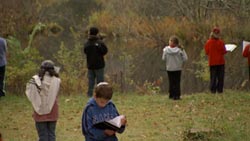 |
| Students pray outdoors in nature at the Teva Learning Center. |
But the film shows that Judaism is not the only religion filled with praises of the environment. In Chicago, a Muslim community has partnered with Faith in Place, which established a local farm that raises and slaughters animals in accordance with tradition. This farm has many environmental benefits, like limiting the carbon emitted from transporting meat from locations farther away. The slaughtering process is also more humane and harms the environment less than modern practices. The film also documents religious and ecological achievements in several churches and one Buddhist community.
“Religions speak to the deepest dimensions of human experience and the ways we morally and ethically choose to lead our lives,” says lead filmmaker Martin Ostrow, who has an extensive film history, including work for PBS and an Emmy nomination. Ostrow and his team worked hard during filming to be as environmentally friendly as possible by traveling in just one car and reducing air travel.
When it comes to making your life greener, Ostrow and Bernstein know that youth hold the most power. As Ostrow explains, “The most terrible thing you can do is to do nothing because you think you’re too young for people to take you seriously.” You’ve heard it before, but it’s extremely easy to change your daily life. For example, energy-efficient light bulbs are now priced the same as regular bulbs and last substantially longer.
With the help of organizations featured in the film, such as the Teva Learning Center, ADAMAH: The Jewish Environmental Fellowship and the Interfaith Power and Light campaign, there are opportunities for teenagers to get involved and make changes in their religious and secular communities.
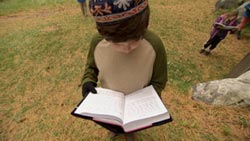 |
| A young student prays with his sidur outside. |
At the very least, visit the film’s website at renewalproject.net. You can order copies of the DVD and even organize a local screening. And for more on Judaism and the environment, check out the brand-new ecological track at this summer’s CAJE 33 in Vermont. There are even scholarships for college students to attend.
I promise the film will help you see religion and life in a new light. It brilliantly illustrates the hope in our country for reuniting humans with the world around them. Perhaps with enough passion and commitment, we can make our way back to the Garden of Eden.
Ben Tepfer is 17 and a senior at Gann Academy in Waltham, Mass. He is the president of the school’s Junior State of America chapter and runs a club called Students Taking Action. On the weekends, Ben often goes to concerts, hangs out with friends and catches up on his favorite TV shows. He's also a member of the JVibe Teen Advisory Board.
DVD.Town.com Article on Renewal
DVD Review by James Plath, Staff Writer, DVD.com
Anyone who’s paid attention to the U.S. presidential elections over the past 20 years knows how polarized the country has become. On the one side are pro-environment, pro-choice, pro-government-services, and pro-labor liberals. On the other side are pro-life, pro-state’s rights, pro-gun, and pro-business conservatives. Though there are churchgoers on both sides, the “religious right” has claimed family values for the Republican party and has been an influential force in advancing the conservative agenda. That’s why it’s so striking--even shocking--to watch this documentary from Marty Ostrow and Terry Kay Rockefeller, because “Renewal” bears witness to an emerging religious-environmental movement. That’s right. Evangelical tree-huggers.
What’s more, in one of eight segments illustrating stories of save-the-planet actions taken by whole congregations, we even see Chicago Muslims and downstate Illinois Christian farmers coming together because of environmental issues. All of the stories tell a tale of community activism, but the filmmakers are also activists. The packaging and the “Renewal” website indicate that they hope the film will inspire more faith-based conservation efforts.
The 90-minute film begins with a trip to eastern Kentucky and an introduction to a Catholic priest and the Catholic Committee of Appalachia’s combined efforts with other groups like Christians for the Mountains to stop mountain-top removal coal mining. Ostrow and Rockefeller’s style is to intro and outro each episode with footage of the natural world, move from voiceover to talking heads on camera, then document the group in meetings, interaction, or direct action. I personally could have used a little more variation and less artsy and protracted nature shots (which began to feel a little like video-audio screensavers), but the topic itself and the case studies that the filmmakers chose are strong enough to make up for these slight stylistic deficiencies.
“Renewal” isn’t a preachy film, but it does have a clear point of view, and given the relatively large number of scriptural references to stewardship, it would seem that the film is aimed at convincing more spiritual and church-going people to follow the example of these committed people. “If you love the creator, we should take care of creation,” says Peter Illyn of Restoring Eden, an Evangelical group. Mountain-top removal clogs rivers and valleys, causing flooding, and it strikes him as a “rape” of the mountain. It’s an epiphany for him and others in Restoring Eden, and Illyn, like the filmmakers, believes that epiphanies need to be shared--hence his participation and this film.
It’s more than epiphanies, though, and the filmmakers know it. “Renewal” is a sourcebook of ideas for congregations who might be wondering what they can do in order to be better stewards of the world that they were born into. Maybe it will be a segment on a husband-wife minister team in Highland Park, New Jersey and their Green Faith efforts to make their church self-sufficient by putting solar panels on the rooftop, giving consumer quizzes to parishioners, and doing dumpster dives to see where they could all improve. In this segment, as others, we see them both in physical and spiritual action, with the new solar roof dedication sparking praise:
“Barrels of oil consumption avoided, 19.68.”
Thanks be to God.
“Pounds of coal consumption avoided, 11,153.”
Thanks be to God.
Or maybe people will find inspiration from the Northbrook Mosque in suburban Chicago, whose reaction to the animal abuse in the poultry and cattle industries and resultant high level of antibiotics in the meat caused them to look for organic farmers who treated their animals with respect, as the Koran prescribes. We see shots of them praying inside the mosque and the lead person on this venture, a woman named Shireen, taking tours of farms and talking with the farmers. In the process, we watch a dialogue emerge on religion and environmentalism, and amazingly the segment concludes with everyone sharing a chicken meal. Cultures come together as well in an Albuquerque, New Mexico sequence that unites Catholics and Native Americans in a common cause to conserve and clean up the water supply.
Maybe it will be the Tena Learning Center approach that will inspire, with a Jewish organization following teachings in Deuteronomy, Isaiah, and Ecclesiastes to become better stewards of the land. Their approach was to raise a new generation who would treat the earth better, and their method was to create an environmental camp for students that’s attended by several thousand annually. We see the campers learning about nature in the field but also weighing their uneaten food in the cafeteria and measuring the amount of food that they waste per meal.
“When you are really in touch with the majesty of creation, your first response is wow, and that wow is the basis of prayer,” one of the teachers explains.
The filmmakers tried to include all religions, and we get a segment on Buddhists campaigning to save trees in the San Francisco Bay area. Scattered throughout the film are scriptural justifications and environmental facts, such as this revelation: “If every household used a four-pack of recycled toilet paper, it would save 1.2 million trees per year.” Which kind of makes you wish that more people would have taken the free sample roll they were offering passers-by on the streets, rather than scrunching up their noses. There’s a little anti-government activism here, too, with a small Mississippi town battling industrial contamination and a community trying to get back on the road to health following the government’s Hurricane Katrina botch-up.
And did I ever think, given the guffaws directed against Al Gore, that I’d see Christian conservatives working hard to battle global warming? As I said, this film is an eye-opener, both in regards to what’s currently happening, and also what’s possible in the future. If people can find common ground taking care of the Earth, maybe, just maybe, they can find common ground elsewhere too, and religion can be a force for good rather than a simmering pot of ethnocentric contention.
Ostrow and Rockefeller have directed episodes of such PBS series as “NOVA,” “American Experience,” and “Eyes on the Prize,” and “Renewal” will air on PBS stations in Kentucky and Ohio this month. DVDs are currently available at the“Renewal” website.
Video:
The “Renewal” project was funded in part by a grant from The Kendeda Sustainability Fund and sponsored by The Center for Independent Documentary, and production values are solid. Colors are natural, and for a standard definition there’s decent clarity and edge delineation, with only the slightest level of grain throughout. The box says it’s playable in 1.33:1 or 1.66:1 aspect ratios, but if so, then the pan-and-scan version appears as an Easter Egg somewhere. There’s no way to adjust the audio or video on the menu screen. Just “Play Movie” or choose your selection for an extended segment.
Audio:
The audio appears to be a Dolby Digital 2.0--nothing fancy. Then again, the film is mostly dialogue. In some of the exterior scenes we get a little too much wind action on the microphones, and there’s an overall flatness to the timbre. But there’s no distortion, and the volume level is consistently maintained.
Extras:
There are approximately 20 minutes of outtakes that were removed so the film could make the festival rounds at 90 minutes, and the extra minutes were left in the individual stories. Click on them and you get the expanded version. As you might expect for an environmentally-conscious release, the packaging is a 100 percent recyclable cardboard sleeve. Now, I personally think these cases are hard on DVDs and can lead to scratches, but I can appreciate the filmmaker’s packaging dilemma.
Bottom Line:
Ostrow and Rockefeller don’t do anything fancy in “Renewal,” and when they do attempt to get a little more artsy it gets in the way of the film’s central thrust. But they’ve assembled eight stories that are fascinating examples of possibility--examples which raise hope both for the future of our planet and religion as well. DVD review by James Plath, Staff Writer, DVD.com
Boston Globe article on Renewal
Renewal Spreads the Environmental Gospel By Ty Burr, Globe Staff, The Boston Globe
'Renewal' spreads the environmental gospel
Global warming makes strange but useful bedfellows. "Renewal," a documentary by Marty Ostrow and Terry Kay Rockefeller opening at the Museum of Fine Arts today, traces the rise in environmental activism among religious communities throughout America.
The congregations include evangelical Christians in Kentucky and Muslims in Chicago, Connecticut Jews and Mississippi Baptists. All are striving to preserve what they see as God's creation, and all are increasingly working together as conscious stewards of the earth. Says one of the committed, "What gives me hope on this is that I've never seen a wider coalition."
The film, accordingly, is earnest, idealistic, and fired with the righteous potential of making a difference. And maybe it's right to: When New Mexico Catholics and Native Americans joined forces recently to protest development that was siphoning water from farms, the results were a very pretty community celebration - and pro-environment resolutions passed by the local planning commission.
"Renewal" is really eight short documentaries stitched into a 90-minute whole, each focusing on a local action spearheaded by a different religious organization. Catholics and evangelicals in Appalachia raise awareness of the coal-mining practice known as "mountaintop removal" by flying over in helicopters and videotaping the devastation. (Later they sing "Amazing Grace" while dynamite detonates nearby cliffs.) New Jersey's GreenFaith organization outfits churches with solar panels while teaching them to reduce their own consumption.
California's Buddhist Green Sangha petitions The New Yorker and National Geographic to print on recycled paper; the Teva Learning Center in Falls Village, Conn., teaches Jewish kids about nature and waste. (One of my favorite scenes in "Renewal" shows a group of blindfolded tweeners led up to a mountain ridge and then told to take the blindfolds off. "Oh my God," they exclaim when they see the view, which sums up the film's message in three simple words.)
The two most inspiring segments of "Renewal" - which, after all, exists to inspire - concern Muslims in suburban Chicago and Episcopalians in San Francisco. In the former, a young mother named Shireen Pishdadi contacts rural organic chicken and beef farmers to bring healthy halal food to her religious community. The triangulation between Muslim beliefs, middle American agriculture, and the new philosophy of food promulgated by writers like Michael Pollan gives one hope for the future of eating and civilization.
Led by the Rev. Sally Bingham of San Francisco, the Interfaith Power and Light campaign is a 24-state multi-denominational response to global warming that in one exhilarating sequence descends on Washington to merrily browbeat various elected representatives. "Renewal" documents that religious zeal can be yoked to change as well as conservatism, that differing faiths can speak to each other, and that, really, good works are faith these days. Above all, the film spreads the good news that we're just getting started.
Reviews About Renewal
Biohabitats Film Review: RENEWAL
by Amy Nelson 12-22-15
As people involved in environmental restoration we understand the power of transformation in the landscape, even the kind which can take decades. Amidst the mounting onslaught of environmental doom and gloom, these transformations offer us hope and provide glimpses of a possible future that differs from the apocalyptic and conflict-fueled visions so common in the media these days.
In the documentary film RENEWAL, we witness a different, but equally inspiring kind of transformation within religious people, communities, and organizations in the U.S. who are reexamining what it means to be in communion with Earth and gaining a new understanding of their role in caring for the environment. Produced in 2007 by documentary filmmakers Marty Ostrow and Terry Kay Rockefeller, RENEWAL is billed as the first feature-length documentary film to capture the vitality and diversity of religious-environmental activists. The 90-minute film is broken into eight vignettes that feature Christians, Muslims, Buddhists, Jews, Native Americans, and several interfaith organizations. Read Full Article>>
Eco-Journey
(the blog of the Environmental Ministries Office of the Presbyterian Church (U.S.A.)
"Renewal" Documentary Offers Inspiration
DVD Showcases People of Faith Working for Eco-Justice
by Katie Holmes, August 4, 2011
Renewal is a documentary with eight stories of how people of faith are working to create environmental justice. The documentary is inspiring, and can be used to involve more people of faith in this important work. The documentary has an accompanying study guide, which can be downloaded online, and used in your congregation. As the film is broken down into 8 short stories, it lends itself well to use in a series of educational classes on caring for creation. Renewal's website also includes a screening guide with helpful tips for planning a screening.
Regardless of where your church is on its journey for eco-justice, Renewal can serve as an inspirational tool. It provides wonderful examples to inspire action in churches that are just getting started in eco-justice work, as well as churches that have long been active and may be looking for new ideas or a new option for eco-justice education. Read Full Article>>
From Community of Christ, Herald
(Volume 158 No. 4)
"Film Uplifts Sacredness of Creation"
by Brad A. Martell, Peace and Justice Ministries
In 2008, I saw the premier of the documentary, Renewal: Stories from America's Religious-Environmental Movement, and I excitedly waited for the DVD to be released.
The film quickly filled my mind with ideas for use in my ministry. For me, it's an invaluable resource, and I hope it will be for you and your congregation, too.
Renewal is a 90-minute film of eight inspiring stories. They show how faith communities are addressing today's environmental challenges. Read Full Article>>
The BioLogos Forum
“Ninety Minutes Well Spent”:
A Student’s Review of RENEWAL
[BioLogos' "Science and the Sacred" is pleased to feature essays from various guest voices in the science-and-religion dialogue. Please note the views expressed here are those of the author, not necessarily of The BioLogos Foundation.
This review was written by Kelsey Luoma. Kelsey Luoma is currently a senior at Point Loma Nazarene University in San Diego, California. She will graduate with a bachelor's degree in biology and plans to continue her education in medical school. As an evangelical Christian and student of biology, Luoma is very interested in resolving the conflict between faith and science. In the future, she hopes to serve internationally as a physician.]
Like many of my college-aged contemporaries, I have in recent years become rather selective in the movies and media I choose to absorb. When one’s daily planner is soaked through with ink and coated in illegible reminders of exams, research papers, club meetings, social obligations, work hours and volunteer commitments, it becomes necessary to filter out a great deal of unnecessary movie-watching time. Some videos, however, are well worth the effort spent to rearrange one’s daily to-do list and sit down for an hour or two. Lately, I was given the opportunity to expand my knowledge of how religion and science can work together through the documentary RENEWAL (read a post from one of the film's creators here). Another ink-scribble was added to my planner, and I carved out time to absorb the content of this inspiring documentary work. They were 90 minutes well spent. Read Full Article>>
The Huffington Post on Renewal:
The Renewal of Religious Environmentalism
by Michael Zimmerman, Ph.D.,
founder, The Clergy Letter Project
At least as far back as the publication in 1967 of the seminal but highly controversial essay, "The Historic Roots of Our Environmental Crisis," by historian Lynn White, Jr., the relationship between religion and environmentalism has been a complicated issue. White argued that Christianity "not only established a dualism of man and nature but also insisted that it is God's will that man exploit nature for his proper ends."
Many religiously affiliated individuals have taken even more extreme and far less nuanced positions. Consider, for example, the position staked out by John Shimkus, a Republican member of Congress from the 19th district in Illinois. He's made it clear that we need not be concerned about environmental problems because God promised Noah that the earth won't be destroyed again. "The earth will end only when God declares its time to be over. Man will not destroy this earth." It's well worth noting that Shimkus is not just a random member of Congress. He holds a seat on the powerful House Energy and Commerce Committee and, as frightening as it might seem, he chairs its Subcommittee on Environment and Economy. Read Full Article>>
Boston Globe article on Renewal
Renewal Spreads the Environmental Gospel by Ty Burr, Globe Staff, The Boston Globe
'Renewal' spreads the environmental gospel
Global warming makes strange but useful bedfellows. "Renewal," a documentary by Marty Ostrow and Terry Kay Rockefeller opening at the Museum of Fine Arts today, traces the rise in environmental activism among religious communities throughout America.
The congregations include evangelical Christians in Kentucky and Muslims in Chicago, Connecticut Jews and Mississippi Baptists. All are striving to preserve what they see as God's creation, and all are increasingly working together as conscious stewards of the earth. Says one of the committed, "What gives me hope on this is that I've never seen a wider coalition." Read full article >>
Library Journal
Renewal: Stories from America's Religious-Environmental Movement. color. 90+ min. Marty Ostrow & Terry Kay Rockefeller, Fine Cut Prods., LLC, www.renewalproject.net; Neoflix, PO Box 5665, Hacienda Heights, CA 91745; 626-388-7974. 2008. DVD $39.95; acad. libs. $250. Public performance; closed-captioned. ENVIRONMENT
This "documentary about people of faith building a sustainable future" is divided into nine programs that average under 12 minutes each—a terrific length to spark conversation and debate. Coming from the tenets of Judaism, Catholicism and other Christian denominations, Islam, and Buddhism, these ecofriendly and conservation/recycling ideas are equally as broad and include camps for kids to teach them about God's earth and our responsibility to maintain it as emphasized by ancestral practices; solar power in churches and garbage inventories; ethical and natural food creation; and campaigns to better our world by shedding light on coal companies that are performing mountaintop removal and attempting to convince publishers that using recycled paper and natural inks are fiscally prudent and can be done without aesthetic compromise. The juxtaposition of environmentalism and faith is on the rise, and this DVD stands as a microcosm of this broad movement. The technical quality of the production is solid, and the packaging is recycled. Recommended for most libraries.—Brian Burns, Hampden-Sydney Coll. Lib., VA
Creation Care Magazine
RENEWAL: Stories from America's Religious Environmental Movement
DVD new release, reviewed by Rusty Pritchard
Marty Ostrow and Terry Kay Rockefeller have produced a beautiful documentary look at the surprising growth of environmental awareness and action, not in an interfaith context, but in a broad set of distinctive religious contexts. With compelling stories and images, they chronicle evangelical, mainline, African American, Catholic, Jewish, Muslim and Buddhist American communities as they work to become better stewards of creation. Evangelical viewers will be glad that the film does not promote a soft-headed blending of traditions, but instead explores the diversity of faithful religious expressions on environmental problems. Commonality emerges on its own, as the groups all appear to struggle with what it means to be fully human in the midst of a dominant culture of profligacy and recklessness.
The documentary runs 90 minutes, but each of the segments highlighting a particular faith community is also presented in a standalone format, with extended footage. The segments work well on their own in small group and workshop settings, for starting discussion and providing fodder for conversation. The nature of the film also makes it useful for congregations wanting to host an interfaith dialogue using material that respects the various traditions. For my full review, search for "Renewal DVD" on the deepgreenconversation.org website.
Utne Reader
A Green Spiritual Awakening by Keith Goetzman
Kids at a Jewish camp weigh their food waste each day in an attempt to pare it down. Christians sing "Amazing Grace" as another Appalachian mountain is blasted to bits for coal. Muslims in suburban Chicago seek out a local producer of humanely raised, organic, halal meat. The stories of faith driven environmental consciousness in Renewal drive home the point that the green movement is amassing some serious prayer power. It's not a backhanded compliment to say that the film is a hit on the church-basement circuit.
Sojourners Magazine
Visions of a New Earth
The film Renewal: Stories from America’s Religious-Environmental Movement contains eight compelling stories of faith-based activism around the country—including how evangelicals have mobilized against mountain-top removal in Appalachia, the ways Catholics and Native Americans have joined to protect natural resources, and what a Jewish camp teaches kids about the environment. The 90-minute doc is great for small groups, as the eight segments can stands alone. www.renewalproject.net
DVDTown.com Article on Renewal
DVD Review by James Plath, Staff Writer, DVD.com
Anyone who’s paid attention to the U.S. presidential elections over the past 20 years knows how polarized the country has become. On the one side are pro-environment, pro-choice, pro-government-services, and pro-labor liberals. On the other side are pro-life, pro-state’s rights, pro-gun, and pro-business conservatives. Though there are churchgoers on both sides, the “religious right” has claimed family values for the Republican party and has been an influential force in advancing the conservative agenda. That’s why it’s so striking--even shocking--to watch this documentary from Marty Ostrow and Terry Kay Rockefeller, because “Renewal” bears witness to an emerging religious-environmental movement. That’s right. Evangelical tree-huggers. Read full article >>
Video Librarian
Filmmakers Marty Ostrow and Terry Kay Rockefeller's Renewal is comprised of eight documentary vignettes, each recording an incident that demonstrates a connection between religious practice and environmental activism in the U.S. The episodes briefly sketch a number of different approaches taken by practitioners of various traditions: Christianity (including evangelicals, Roman Catholics, and several Protestant denominations), Judaism, Islam, Buddhism, and Native American beliefs. One New Jersey congregation updates its facilities to conserve energy; another in Mississippi fights industrial contamination. A mosque develops a relationship with sustainable farms, while a Jewish learning center incorporates environmentalism into its traditional curriculum, and a Buddhist group acts to save forests. In New Mexico, Catholics and Native Americans join in rituals designed to protect natural resources, while in Appalachia evangelicals protest mountaintop mining. As a whole, the film advances the idea that the Earth is a sacred trust that persons of faith must work to preserve, along the way illustrating various means through which religious communities, interfaith movements, and individual believers can respond to that challenge. DVD extras include extended versions of the eight episodes. Recommended. Aud: C, P. (F. Swietek)
JVibe Article on Renewal
Using Religion to Save the Planet by Ben Tepfer, JVIbe
|
| Students at thUsing Religion to Save the Planete Teva Learning Center weigh a bucket of food waste as part of an ongoing exercise and lesson about consumption. |
As buckets of garbage were poured onto the tarp where he stood, GreenFaith founder the Rev. Fletcher Harper shared with his New Jersey congregation, “The hardest thing about taking action is sometimes just taking the first step.” Their goal was to examine how much waste the church created in one week—and how much of it could be recycled. This was the second step in making the church environmentally sound. The first step had been the installation of solar panels that cost the church virtually nothing; in fact, it saved money on electrical costs. GreenFaith is just one of eight examples given in the groundbreaking documentary Renewal, which tells the stories of religious groups across the country that are looking for solutions to the environmental crisis. Read full article >>
Interfaith Power and Light
While much of the religious-environmental movement is local, Interfaith Power and Light (IPL) has grown to national proportions. The affiliates help people of faith reduce their use of fossil fuels and increase their reliance on renewable energy in all aspects of their lives. At their annual gathering in Washington, DC, IPL leaders lobby Congress for legislative reforms to bring America into line with energy policies to reduce pollution and reverse climate change.
Interfaith Power and Light began in 1998 with Episcopal Power and Light and the support of Grace Cathedral in San Francisco, as a coalition of Episcopal churches aggregated to purchase renewable energy. In 2001, California Interfaith Power and Light was established, to reach out to people of all faiths in California to organize and promote positive environmental change around energy and global warming.
The movement grew under the prophetic and energetic leadership of the Rev. Canon Sally Bingham and there are now Interfaith Power and Light organizations in 29 states, on the way to 50. Some are programs of existing organizations (such as Chicago’s Faith in Place), but most are founded solely as IPL state affiliates. Today, the network represents thousands of religious people who care deeply about the future of creation, and work together to influence federal policies that can help mitigate the worst impacts of climate change. To learn more, visit: https://www.theregenerationproject.org/
Sacred Celebration
The remaining historic farmland in the South Valley of Albuquerque, New Mexico is being rapidly devoured by commercial and residential development. Under the leadership of Franciscan Sister Joan Brown, this community of Hispanics, Native Americans, and Anglos is fighting back. During the festival of San Ysidro, patron saint of agriculture, they gather to consecrate the land that nourishes them and bless the waters that help the crops grow. Religious ritual and sacred celebration become a seedbed for their effective environmental action.
Eco-Justice
In coastal Mississippi, pollution from the chemical and petroleum industries has for decades caused elevated levels of disease - nervous disorders, asthma and cancer - in African American and other poor communities. Then, the flooding caused by Hurricane Katrina made these medical problems even worse. Now, through their churches, citizens are finding inspiration to conduct their own health surveys, to demand accountability from industry and to insist on action by government officials.
Compassion in Action
Buddhists in the San Francisco Bay area are working to save trees by encouraging greater use of recycled paper, especially by major magazine publishers. Their organization, Green Sangha, combines meditation and environmental education to promote non-confrontational forms of action emphasizing the interconnectedness of everyone and everything on the planet.
Ancient Roots
In rural Connecticut, two programs offer unique opportunities for Jewish environmental education. At the Teva Learning Center, elementary school children encounter the natural world as they explore the woods, learn where their food comes from, and take responsibility for waste. At Adamah, a three-month environmental leadership training program, a small community of twenty-somethings engage in organic farming, sustainable living, and contemplative spiritual practice. These future leaders of the Jewish community offer an inspiring model to the Teva students. Together they are renewing the ecological wisdom inherent in Judaism and building a genuine commitment to tikkun olam, healing the world.
Food for Faith
In Chicago, which has a growing and diverse Muslim community, the interfaith organization Faith in Place has supported the development of Taqwa. Taqwa supplies organic meat to the Muslim community and everyone else who wants to support sustainable farming. This chicken, beef, and lamb is "Eco-Halal." The animals are humanely raised, fed an organic diet, and slaughtered in accordance with Islamic law. During the holy month of Ramadan, Taqwa members extend their tradition of charity to insure that poor communities can also eat this healthy and environmentally friendly meat.
Going Green
In New Jersey, GreenFaith, an interfaith coalition helps houses of worship make their buildings more environmentally sound and the members of their congregations more spiritually in tune with becoming better stewards of Creation. From workshops that invite people to explore their personal impact on the environment, to implementing recycling and composting, on up to the installation of solar panels, congregations in New Jersey are making remarkable strides. As GreenFaith's Executive Director says, "The hardest thing about taking action is sometimes just taking the first step."
A Crime Against Creation
In the mountains of Kentucky and West Virginia today's mining practices are literally removing the tops of mountains to extract coal to feed American power plants. The natural environment is being decimated, while burning the coal fuels global warming. Evangelical Christians have participated in an interfaith tour to bear witness to this devastation and to begin organizing against the practices that are destroying the land and polluting the waters of Appalachia.